Jun 25, 2012

Rafting in Tamur river in Nepal


Rafting in Tamur river in Nepal
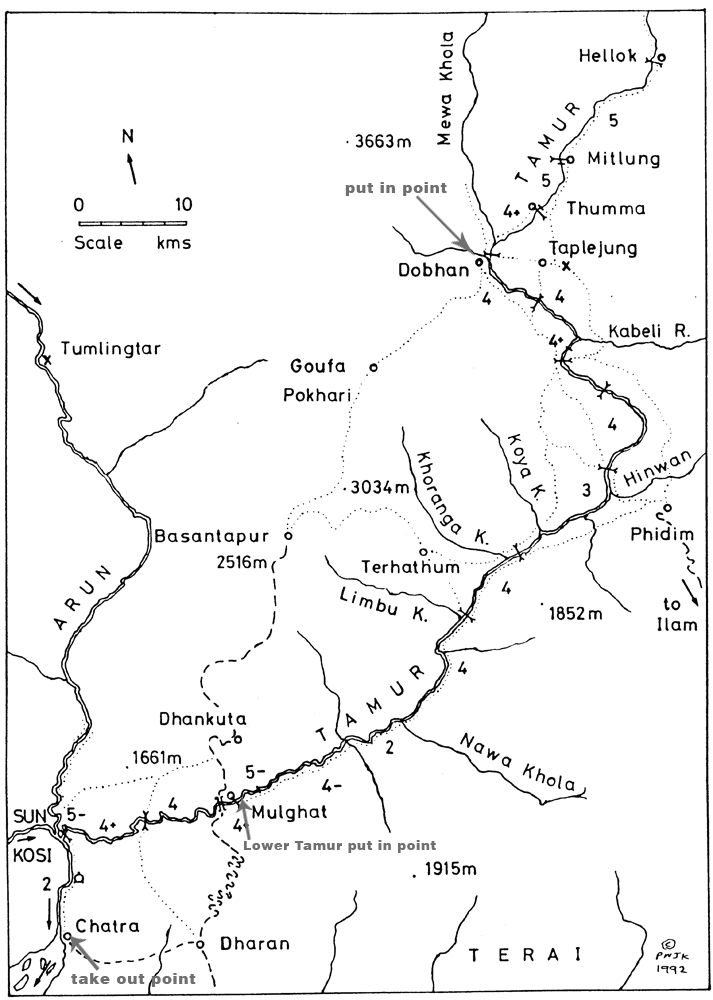
Tamur river rafting Map
Tamur river rafting Map 
Probably the best combination trip in Nepal-magnificent white water, a beautiful unspoiled valley, combined with one of the most scenic treks in Nepal. The Tamur and its tributaries drain the snows of Kanchenjunga third highest peak in the world. The river is the sixth largest river in Nepal and seems to have a feeling of thrusting power and of being constrained by its valley sides. The first commercial run of the Tamur was in 1990 and there have been very few descents since then. It is an outstandingly beautiful river with superb views of the Himalayan range including Mt. Everest, Mt. Kanchenjunga and Mt. Makalu. The river trip includes around 120 km descent through more than 100 of the most exciting rapids still to be named has to offer grade 3 to 4, with some graded -5, making one of the best white water expedition trips in the world.

The trip starts with an internal flight or drive from Kathmandu to Biratnagar in the far South-East of Nepal. We take a private bus drive to Basantapur in the Tehrathum Region, where we camp overnight. The following day, we begin an awe-inspiringly beautiful 5-day trek to Dobhan through the remote Taplejung region of Eastern Nepal. From Dobhan we begin the exhilarating trip, which includes a day relaxing on a remote river beach or an optional one-day trek visiting local villages. The Tamur is best tackled between October and November, and February and May. Finally, there's an overnight drive by private bus or an optional internal fly back to Kathmandu

Departure Point……………..Kathmandu/ Busti
River Start Point……………Devitar
River Finish Point…………Chisopani
River Grade……………….III - IV+


Duration: 10 Nights / 11 Days
  
Day 01:
Fly from Kathmandu to Biratnagar then drive about 5 hours to starting point for the expedition or by from Kathmandu direct drive  to Dhankuta Hile and then the start the expedition.

Day 02-05:
Start our four-day trek into the heart of eastern Nepal. It does not take long to leave all the noise and hassle of town life behind. We will stop for lunch, relax and enjoy the views and culture of local village life. You will only be carrying a water bottle and camera on you as our team of porters carries the main loads (including kayaks and rafts!).

Day 06:
The white water action begins from Dovan. Your expedition leader and your raft guide will give you a detailed safety briefing. Then for the rest of the day (apart from the lunch break of course) you are in a turquoise blue class IV white water paradise. Overnight in Camp.

Day 07:
This is class II-IV the whole day passing through villages and spotting wildlife particular to this area.

Day 08:
Time to have a break. We have a rest day to enjoy the beach life, or go for a day trek to the local villages that are always so welcoming and inspiring with their unending supply of enthusiasm and smiles.

Day 09:
The action continues as you tackle more class ii-iv rapids all the way.

Day 10:
Relax and enjoy a mellow day on the river as you float through the day with the occasional "all forward call" to bring you back into action. You need to relax so you are ready for tomorrow!

Day 11:
There could not be a better way to end an expedition like this other than on continuous class IV for half a day. Perfect action on the perfect river. We end the journey in Chatra. Those who choose to fly will be drive to Biratnagar airport to catch their flight 1-hour or drive to Kathmandu.

Rafting at sabaiya Khola Nepal


Rafting at sabaiya Khola Nepal
Nepal has four major river systems with more than two - hundred fifty sizeable tributaries .The major rivers are: - The Sapta Kosi in the extreme eastern Nepali; the Narayani in the central Nepali; the Karnali in the western Nepal and the Mahakali in the far western Nepal . Arun rivers are one of the tributaries of river Sapta Kosi that flows in the Eastern Nepal . Besides being the only Hindu country in the world with all to myths and mysterious character, Nepal has more than one hundred different dialects speaking people belonging to various ethnic groups. Meeting there different ethnic groups of people during the rafting is all a part of adventure.

Departure Point…………………Kathmandu
River Start Point……………..Tumlingtar
River Finish Point…………….Chattara
River Grade……………………III - IV

Duration: 05 Nights / 06 Days

Day 01:
Kathmandu to Tumlingtar: - An hour's flight from Kathmandu to Tumlingtar takes you away from the hustle and bustle of Kathmandu . The Tumlingtar flight if scheduled in the afternoon, the camp shall be put up in Tumlingtar itself. The afternoon could be spent in visiting this tiny village with its small teashops and airstrip. Briefing for the next day's trip in the evening.

Day 02:
Savaiya Khola Breakfast will normally be served at 8: 30 AM . Trek for about two hours at a gradual pace until Sabiya Khola. Briefing for the next day's schedule. Get the equipments ready to start early for the following day.

Day 03:
Megan Besi As soon as we get on the river. From Tumlingtar, we get started at 9:30 AM after breakfast. Today is pretty smooth except for little rough ones of grade III/IV.

Day 04:
Today could be more challenging than the previous days. We come across quite a number of rapids one after another. The first encounter is a left- bend rapid, before the suspension bridge at Ranighat. A number of rapids follow after this, one after another we finally camp nearby blithe rapid.

Day 05:
Today is pretty smooth and relaxed compared to the previous days. The Arun River now merges with river Sunkosi to form in to a confluence of river Saptakosi, one of the major rivers of Nepal , which further flows to merge with the famous Gange in India . Float along Saptakosi for another half an hour and we reach the site of a temple in Bara Chettra a Hindu temple dedicated to lord Vishnu. From here, float for another half an hour to Chattra. Drive back.

Day 06:
Arrive Kathmandu .

Jun 22, 2012

Rafting in Karnali river Nepal

Rafting in Karnali river Nepal
Rafting in karnali river
Rafting in karnali river 


Nepal’s longest and largest river, the Karnali, springs forth from the base of Mt. Kailash in Tibet , the center of the universe for both the Buddhist and Hindu religions. Flowing south into Nepal it forms the major drainage system of the western districts.The Karnali is one of the finest BIG volume river trips in the world, a classic expedition into Nepal 's remote, unpopulated "wild west".
From our starting point at Sauli the river drops into imposing canyons filled with powerful, big volume white water. These canyons flow into scarcely populated areas of pristine jungle teeming with abundant bird and wildlife. Rapids like "Captivity", "Flip and Strip" and "Gods House" are separated by just enough easier water to regroup and prepare for the next big challenge.
Towards the end of the trip the river gradient begins to ease as the Karnali leaves the mountains and flows out into the Gangetic plains of the Terai. The jungle thickens as the river broadens, and the pristine Beaches become bigger and more beautiful.
This is an ideal opportunity to go to Bardia National Park and the resort from Chisopani will collect you. This would include two nights in the park and full safari activities including elephant rides.

Departure Point……………..Kathmandu or Pokhara
River Start Point……………Sauli
River Finish Point…………Chisopani
River Grade……………….III - IV+
Duration: 10 Nights / 11 Days

Day 01:
We meet at the office at 7am (Pokhara or Kathmandu ) with your bags ready to go. This is a long bus journey, so be prepared with water etc. We travel to the far west and arrive in Surkhet very late/early hours of the morning. You are able to have a sleep here.

Day 02:
After breakfast, we will take a truck as far as the road goes until about lunch time (this all depends on availability...be flexible). After lunch we walk all afternoon to the put-in point at Sauli. A great walk which highlights just how "out there" you really are. You pass local villages and spectacular scenery, then.......you hear the river!

Day 03:
The river gives the team time to build and there is enough challenging rapids and water flow to allow for learning errors. We still manage to get at least one great class iv rapid in. We camp and get excited about tomorrow.

Day 04:
This is the type of day that people imagine when they think of Himalayan water. It is BIG and it is continuous. We enter into the Jungle Corridor. This is a narrowing jungle clad gorge and it is all ours. The team building is put into full practice and when your guide shouts "all forward" he really means it! Enjoy the ride all day and camp in this sensational setting.

Day 05:
More of the same including the notorious GOD'S HOUSE rapid. Don't forget to take in the bird life which is equally as abundant as the lush vegetation. Camp and relax.

Day 06:
It isn't over yet! Keep paddling hard ! You really are experiencing the best of the west on yet another day of great action and breath taking scenery.

Day 07:
This is a holiday after all, so we have programmed a rest day so you can take time to enjoy your surroundings and relax on a great sandy beach.

Day 08/09:
We see the rapids dying off as we come out of the gorge. We pass the confluence with the Seti river where the river broadens. Today and the next day and a half are a chance to enjoy your journey admiring the country and villages you pass. You will have seen the safety kayakers in action and will no doubt be inspired, so ask the guides for some supervised instruction, or take over the raft and learn about the river. You see there is more to a rafting expedition than just rafting.

Day 10:
We come to the end of our journey at about lunch time where our bus will be waiting to collect us. Those who have booked to go to Bardia National Park (highly recommended!), will be collected from here as well.

Day 11:
We arrive back at Kathmandu/Pokhara, in the early morning of the eleventh day. What a journey !!!

Rafting and kayaking in sunkoshi in Nepal


Rafting and kayaking in sunkoshi in Nepal 
Sunkoshi river rafting map
Sunkoshi river rafting map 

The Sun Koshi ' River of Gold ' has been rated as one of the top ten rafting trips in the world! It is also in the list of 'must do while in Nepal'.The river rises near Shisha Pangma in Tibet and runs eastwards, draining the highest mountains of the world before emerging on the plains of India, where it joins the Ganges. Our journey takes us 270km through some of Nepal 's most remote regions giving you a unique wilderness experience. The first two days are relatively easy and allow time to train you as a team before the bigger rapids arrive. The rapids have acquired names like Meat Grinder, High Anxiety, Jaws and Big Dipper, from previous experiences on expeditions. Say no more! The calmer stretches between rapids give you time to take in the phenomenal views, swim (voluntarily) in warm water and camp on white sandy beaches. This river is a BIG volume HIGH adrenaline expedition!!!


Departure Point……………..Kathmandu
River Start Point…………….Dolalghat
River Finish Point…………..Chattra
River Grade………………………..IV - V

Duration: 07 Nights / 08 Days

Day 01:
Morning at 7 am meet in Ktm. office - store baggage and finalise plans a quick breakfast then we drive to Dolalghat the put-in-point of Sun Kosi. The drive is beautiful. In clear weather you will have a magnificent view of the Himalayan Ranges . Upon arrival at Dolalghat we unload the gear - lunch will be served and a full safety briefing will be given by your expedition leader. The first and second days are easy paddling. The big one you will encounter today is a class 4+ rapid " Rotten Cave ". We will choose our beach campsite, where dinner will be served amidst the splendor of the star-filled sky.

Day 02:
Have breakfast pack up the gear and start rolling down the river. Today you will encounter a big class 4+rapid " Meat grinder". It is fairly straight run down the center avoiding holes left and right. A few meters below here the Tamba Kosi river joins the Sun Kosi on the left with a beach on the confluence. There is another beautiful Shiva temple overlooking the two rivers. We camp here.

Day 03:
Today a few kms below the confluence of the Likhu Khola is a short, class 3+ rapid 'Pre-Anxiety' soon followed by a long class 4 rapid 'High Anxiety' with a large hole on the left halfway down and a series of holes at the bottom. Float a while and then camp.

Day 04:
This day starts with several class 3+ rapids then a quick stop for buying food and maybe beer. Then prepare for a big and interesting one 'Harkapur 2 and 3 the hardest rapid on the river which should be carefully scouted. Camp.
Day 05:
Some kms below Harkapur, Dudh Kosi river joins the Sun Kosi from the left. Below here the river widens into an arid area of gravel. You meet some small rapids an will teach you into another aptly named rapid 'Jaws'. Camp.

Day 06:
Today is a hard day as you will be encounter most of the grade 4+ rapids - you are straight into good exciting rapid "Rhino Rock" which is a grade 4+ followed by "Jungle Corridor" a kilometer of continuous white water. Waterfalls cascade on both sides of the river. One waterfall makes a great spot for a team shower. Camp.

Day 07:
Last few days are mainly wave trains if you are interested you can try kayaking where our experts will teach you the basic skills needed to maneuver the boats or learn the Eskimo roll. Camp.

Day 08:
The last stretch of river which brings you to the last class 4+ 'Big Dipper' is a series of huge standing waves. A few kilometer later Big Arun and Tamur rivers joins together to form the Sapta Kosi. Then you float along on the powerful current, the hills dramatically give way to totally flat Terai and the northern plains of India . This is the end of a classic and memorable river journey. We will finish our trip around 2 pm pack the gear and then drive back to Kathmandu around 4 pm from Chattra. This takes around 13/14 hours .

See you in Nepal ....................................

Rafting and Kayaking in Marsyangdi river Nepal

Rafting and Kayaking in Marsyangdi river Nepal
Marshayangdi River Rafting map
Marshayangdi River Rafting map 
Marsyangdi River rafting is the perfect trip for white water expedition in Nepal. Marsyangdi river rafting is the best and challenging white water runs in the world. Marsyandi River rages through narrow gorges and canyons and past stunning Annapurna Mountains. Marsyangdi River is the most outstanding class-5 rafting and kayaking river in the world. Marshyangdi river rises on the northern slopes of the Annapurna Himal, flows east through an arid valley around Manang, and then swings south to join the Trishuli river at Mungling. Marshyangdi is the raging River in Nepal and best class 4 kayaking rivers in the world which exhilarate whitewater with magnificent mountain backdrops. Marsyangdi river white water rafting is totally different from the big volume rivers like the sun Koshi and Karnali, the rapids are technical and require a very different approach.
Marshyangdi River recently opened for commercial rafting. Marshyangdi is one of Nepal’s steepest rivers, combing with glorious views and its fascinating natural surrounding and typical culture it makes for an incredible trip. Marshyangdi offers some breath taking scenery as it snakes its way beyond Manaslu and Annapurna through forests and traditional villages. Rapids are continuous, very challenging and very committing. This solid white water is a serious trip, certainly not one for the faint of heart. Incredible Marshyangdi River trip offers some breath taking scenery combining with glorious views and its fascinating natural surrounding and typical culture. Marshyangdi River is an ideal choice for those who want to explore an intense and extreme rafting trip in Nepal. Marshyangdi raft is suited trip for previous rafting experience.
Marshyangdi river journey takes us 47 km through some of Nepal’s remote areas giving you a unique wilderness experience. Marshyangdi River white water rafting is trip start from Nagdi and end at Bimalnagar. Best season for Marshyangdi River rafting is November, December, March and April. Marshyangdi River rafting operates in camping basic only. If white water rafting itinerary is not suitable for you, we design another itinerary as per your desire and duration of holidays.

Departure Point………..Pokhara or Kathmandu
River Start Point…………Nagdi
River Finish Point……….Bimal Nagar
River Grade…………….III - IV
Duration: 04 Nights / 05 Days

Day 01:
After breakfast, we leave  for Besisahaar. The last four hours of this ride takes us off the "good" tarmac roads and tends to be a little bouncy in places We have scheduled a rest day into the program to allow for any unlikely but potential delays. That night we stay at a teahouse.

Day 02:
We start trekking for a couple of hours to Khudi where we make camp and sleep for the night. We will leave one of our staff to look after the campsite, then we will continue to trek for one hour more to Bulbule. Your expedition leader and guides will brief you and train you on land about safety and paddling. Pay attention as you are straight into the rapids and this river has a way of underlining any Mistakes! Overnight Khudi.

Day 03:
After breakfast, hike up to Nagdi with all the gears to the river put in point. This is the most knuckle gripping section of the river so enjoy it as you will encounter continuous Class 4 rapids. We finish today at Besisahar and have a well earned dinner no doubt a rum punch to help it down.

Day 04:
This is the day to relax, go walking and learn to roll in a kayak and have a day in this beautiful area, away from the crowds of trekkers. The only reason this day is lost is if there are any problems on day one as explained.
Day 05:
The river becomes very mellow and goes through a high walled gorge with birds and vegetation that can only be described as breath taking. We reach our take out point at Bimal Nagar by lunch time where our Transport is waiting to take us back to Kathmandu/Pokhara.

Rafting at Bheri River in Nepal


Rafting at Bheri River in Nepal 

Bheri river rafting trip known as a new and less crowded rafting Destination of Nepal situated in western part of Nepal. Bheri River is a remote and easy river decorated with amazing scenery, good fishing, unspoiled villages, local people, blue water, white beaches and attractive campsites are main attractions of bheri river white water trip. Bheri River Rafting rises in Dolpa district; its two tributaries the Thuli bheri and Sani bheri join at Ramnaghat to form the main Bheri River. Bheri is located at remote area so Bheri River is relatively unexplored by the rafters and kayakers.
For Bheri river white water trip you have options between taking a one-and-a-half-hour flight to Nepalgunj from Kathmandu or a 627 km long journey by bus. The flight provides you opportunity for the spectacular views of the Himalayas. If you prefer to take a flight, then a four-hour drive is required to reach Samjhighat the put-in point of Bheri rafting. Bheri River is known as an incredible whitewater rafting river of Nepal. Due to its remote location in far- west Nepal, surrounded by lush green vegetation and picturesque landscape. Bheri River is also considered one of the better rivers for fishing. Bheri River Rafting can be combined with a jungle safari trip in Bardia national park.
Bheri river journey takes us 142Km through some of Nepal’s remote areas giving you a unique wilderness experience. Bheri River white water rafting trip start from Ramnaghat and end at Chisopani Best season for Bheri River rafting is March to May and Sept to December. Bheri River rafting operates in camping basic only. If white water rafting itinerary is not suitable for you, we design another itinerary as per your desire and duration of holidays.

Departure Point……………..Kathmandu or Pokhara
River Start Point……………Samjhighat
River Finish Point…………..Bardiya National Park
River Grade………………..Class III-IV
Duration: 03 Nights / 04 Days

Day 01:
Fly from Kathmandu to Nepalgunj, it is an hour's flight with spectacular views of the Himalayas . On arrival drive to the put in point Samjhi ghat which will take approximately 3 to 4 hours. The drive it self is a unique experience, winding up through the Siwalik Hills and passing through local village. On arrival at the starting point your own-tented camp awaits you by the bank of the Bheri River. Dinner will be layout for you around the camp.

Day 02:
KUMALGAUN After breakfast we break camps and starts on our adventure down the Bheri River . After 20 minutes, We encounter our firsts big rapid, one of many to come. The Bheri itself is so remote that it remains a relatively unexplored river of west Nepal . The first section of the river is quite rough with twisted bend creating many exiting rapids. We stop for lunch beside the river and take time to explore the surrounding area, bird watch or simply laze in the midday sun. We continue to encounter more white-water and come to the rest on one of the many sandy beaches.

Day 03:
Jamu the "Exciting" section gives way to a narrow gorge section with vertical cliffs of 200-300 feet on either side interspersed with open valley where there are small villages. This area is generally scenic but here too white-water in encountered. Once again we find one of the many pristine beaches for our camp side for the night.

Day 04:
Bardia National Park The final Day on the river still holds a few surprises with several but exciting rapids to be encountered. After an hours float we arrive at the confluence of the Bheri river and The Karnali river. Once again we enter another gorge section, this time opening onto the huge plain plains of the southern tarai region of Nepal . Once through this gorge we enter into the Bardia National Park .

See you in Nepal ------------------------------


Rafting at kaligandaki river in Nepal


Rafting at kaligandaki river in Nepal
Kali Gandaki river Map
Kali Gandaki river Map 

The Kali Gandaki River is one of the major rivers of Nepal for rafting destination. The Kali River begins its journey high on the Tibetan plateau in the kingdom of Mustang border of Nepal and Tiber. The Kali Gandaki river flows southward through a steep gorge known as the Kali Gandaki Gorge (the deepest gorge in the world) or Andha Galchi, between the mountains Dhaulagiri (8167 m) to the west and Annapurna (8091 m) to the east. The river with total catchment area of 46,300 sq km is notable for the deep gorge through which it flows and for a large hydroelectric power in Nepal. The Kali Gandaki River Rafting was first opened to commercial use in 1991 since then adventure lover can enjoy through Rafting in Kali Gandaki River. The journey of Kali Gandaki River Rafting descends through challenging white water, unique cultures and amazing beaches. Being one of the holiest rivers in Nepal, every river junction on the Kali Gandaki is dotted with cremation sites and above ground burial mounds.
The Kali Gandaki is one of Nepal’s very best rivers for whitewater Adventure rafting.Rafting in Kali Gandaki River Rafting begins and ends in Pokhara you need to get there one day before the trip. Kali Gandaki River has some 60 rapids within 72 km of its distance. Over the rafting trip, you are forced to nominate yourself with rapids like ‘Little Brother’, ‘Big Brother’, ‘Rafters Refund’ , ‘walk in the Dark’ at the end of descends; all of them are quite enough to flip a raft. During our three days rafting trip at Kali Gandaki River mostly Grade III rapid-but sometimes really exhilarating grade Iv and Grade IV+- too. It is not necessary to have experience for doing Rafting on Kali Gandaki River, if you have healthy enthusiasm for adventure, don’t mind being wet for whole day, have a sense of humor then Kali Gandaki River rafting definitely will provide you a jolting, roller-coaster ride through a very big bathtub, an exhilarating tussle with natural force.

Departure Point…………..Pokhara
River Start Point…………..Near Beni
River Finish Point……………..Mirmere
River Grade……………..III – IV++

Duration: 02 Nights / 03 Days

Day 01:
At around 7/8 am, we drive for around 3-4 hrs to the put-in point near Beni . Throughout this drive we have stunning views of the Annapurna and Dhaulagiri peaks as well as the sacred Machapuchare. Upon arrival, we unload all the equipment and you will receive a full safety briefing. Have lunch and then the guide will take you to the river starting point ready to begin your exciting 3 days raft trip. First day we begin with some class III rapids this is a warm up for the team, after 10/15 minutes you will be encountering 2 big class 4 rapids i.e. 'Small Brother' and 'Big Brother'. Your guide will be making you work hard at doing exercises to work as a team maneuvering the raft efficiently. After scouting the rapid, the safety kayaks will go first then the raft. Soon after encountering these two big rapids we will reach the Modi Khola confluence where we will choose the beach for the evening campsite. We unload the rafts and one raft team prepares dinner and rum punch whilst the others play or relax and take in the scenery.

Day 02:
Once the rafts are packed we start down the river for a day mixed with adrenaline calm and spectacular scenery including views of Annapurnna 1 and Himachuli. We will tackle many class III sections and the challenging class IV named REFUND. This section of river is abundant with vines, wildlife and lush vegetation hanging from the cliff faces. Our campsite is below the village of Purti Ghat

Day 03:
Soon after being back on the water we reach the holy village of Seti Beni . The river has deposited a house size boulder in the confluence with a smaller tributary. Since confluence is considered holy places in the Hindu religion, this boulder has become an important shrine to the local river people. There is usually a great audience to watch and listen to the spectacle as each team negotiates the rapid that has formed around this holy place. Not long after this it is time for the journey to end. Our bus will be waiting for us. We load up the gear and prepare for the bus journey back to Pokhara. 

Rafting and Kayaking in Trishuli River In Nepal


Rafting and Kayaking in Trishuli  River In Nepal
Trisuli River Rafting map
Trisuli River Rafting map 


The Trishuli being the most easily accessible river by far a rafting trip on this river can be made for a varied durations, depending upon the availability of time and interest. A brief account on a common Trishuli trip is presented below.

Departure Point…………..Kathmandu or Pokhara
River Start Point…………Charaundi
River Finish Point…………Simaltal
River Grade……………..III

Trishuli river Rafting  in Nepal (1/2/3 DAYS)


One day rafting in Trisuli River

From Pokhara or Kathmandu or Chitwan to Kurin ghat by Bus and rafting in Trisuli and back to Pokhara or Kathmandu or Chitwan

Leave Pokhara or Kathmandu Chitwan early in the morning about 07:00 AM, You will arrive at your raft put-in-point KURIN GHAT after 3.5 hours drive. Upon arrival, you will be met by our river guide. He will brief you about paddling techniques and safety in the river system. After your briefing, load unto the rafts and paddle! Rafting on the Trisuli is a full body activity, with much more than mere paddling. You learn how to throw your body weight around the raft in desperate, yet effective attempts to swing the raft around rapids and through the hydraulics. The total raft time shall be about 3 hours till you reach your put-out-point. During your adventure, you will encounter many small and big rapids.

Once you arrive at your put-out-point. Your pick-up bus will take you to Pokhara or Chitwan or Kathmandu. Arrive at Pokhara or Chitwan or Kathmandu around late evening.


Duration: 01 Nights / 02 Days

Day 01:
We leave Kathmandu or Pokhara around 07:00 Hours and drive approximately 3 hrs. to Charaundi, our put-in point. After the crew assembles the raft, they will explain the safety equipment and proper procedures. During the day, we run a numbers of rapids, that rate to 2 to 3 . All the rapids have been given Nepali and English names: our guide can relate the story behind each one. We lunch on a beach remarkable for its unique sculptured boulders. Shortly after lunch we enter the Trishuli gorge. As the canyon narrows the walls becomes steep, densely, forested, the current accelerates and the rapids increase in the size and frequency. This is the time to hang on. After such a stimulating experience, it is humbling to see a Majhi (Fisherman) building his precarious traps in such turbulence. Our last rapid, Jholungepul, is named for an extensive suspension bridge. Here we often encounter an enthusiastic audience, they line the bridge excited to see us pass beneath. The geologic formation are tremendously interesting and not worthy. We camp at Kurintar on a sandy beach on the Trishuli beach. Every one is welcome to help our crew with camp chores. Once the tents are pitched a savoury dinner will be prepare over stoves.

Day 02:
Our second day has a leisurely pace. After we continue down the Trishuli stopping to suit our interests. We spend the whole day within its forested canyon- one of the many in the Mahabharat range. We eat lunch beside the river and have time to explore, birdwatch, photograph and learn about the local people. The area is inhabited by Magars and Gurung farmers, noted for noted for their friendliness and charm and we have an opportunity for visiting a Vieira and we end our River trip and drive back to Kathmandu/Pokhara/Chitwan.

2 nights 3 days rafting in trisuli River

Day 01:
We leave Kathmandu or Pokhara around 07:00 Hours and drive approximately 3.5 hrs. To Beraini, on the bank of the Trisuli River. When we reach in starting point we prepare everything and give you everyone life jacket, helmet, paddle. Then the trip leader and safety KAYAKER given you information about river safety, paddling technique and another safety method. Then we start the rafting trip.
The first day provides about four and half hours rafting. On the way your can meet different kinds of 3-4 classes rapids. On the middle we stop for lunch, after lunch we do continue until Charaudi which is our campsite.

Day 02:
In the morning at around 8.30 am very one packs their gear and come to breakfast. After breakfast our guide and safety KAYAKER give you another paddle session to refresh every one's memory. This is probably just as well as today we have another four and half hours on the water and we get to run the main canyon section of the Trisuli. In this day you can run main rapids, like Ladies Delight, Upset and Surprise which is most exciting and challenging. Depending on the time we stop to have lunch. After lunch continue until   Gaighat . Spend a night on Gaighat Beach.

Day 03:
The trip continue until Narayanghat . From here it's a four hours bus ride back to Kathmandu or Pokhara. From here also you can go Chitwan for Wildlife Safaris .


See you in Nepal..............................

Rafting and kayaking in Seti khola in Nepal

Rafting and  kayaking in Seti khola in Nepal 


Rafting in Seti River Map 


Departure Point...........Kathmandu or Pokhara
River Start Point………….Damauli
River Finish Point…………Narayanghat
River Grade…………..III

SETI KHOLA 02 DAYS
Duration: 01 Night / 02 Days

Day 01:
We leave Kathmandu in the early morning and drive to Damauli, our put in point. After the rafts are rigged we will set off down the Seti Khola. We spend the whole day within its forested canyon. The luxuriant vegetation we see is a remnant of the vast forested area, which once covered the middle hills of Nepal . Even now we are objects of curiosity to the villagers. Traveling by rafts is a perfect way to view undisturbed.

Day 02:
After we have finished breakfast and repacked the raft, we will set off down river. Later we encounter the technical rapid grade 3 shortly after the rapid we leave Seti Khola and enter Trisuli River . Here the middle hills recede and the Terai plain opens before us. The Topography has changed dramatically. The twisted severe rock formations give away to sandstone and gavel deposited by antecedent rivers. After lunch we have opportunity to visit a unique religious community , Devhgat . Each Year thousands of pilgrims visit the ashram to worship. At this point Kali Gandaki joins the Trisuli River . The river now becomes the Narayani River . We float further down to a small town Narayanghat. Where we end our River trip.

Rafting in bhotekoshi in Nepal

Rafting in bhotekoshi in Nepal 
Bhote koshi river rafting Map

Rafting in bhotekoshi in Nepal

It's a 3 hours bus ride from Kathmandu . The Bhote Kosi is with out a doubt the most action packed short white water run in Nepal . The river drops steeply offering relentless stretches of class III-IV white water. Boulder gardens, small waterfalls, steep chutes and 90 degree bends are just some of the obstacles to be overcome. Like the Marsyangdi, this river is not typical of the big volume waters of the Himalayan, it is steep and technical and requires a reactive crew.The fun doesn't stop there at the end of an action packed day; relax in unspoiled surroundings on the beach.

Departure Point………..Kathmandu
River Start point……….KM 95
River Finish Point……Lomasangu Dam
River Grade……………Class III-IV
The BHOTE KOSHI 02 DAYS

Duration: 01 Night / 02 Days

Day 01:
Meet at the office as per time arranged by your expedition leader at the pre-departure meeting. Then we travel by our private bus to the river starting point of the trip. This is a spectacular drive through villages and if weather permits, you will have fantastic mountain views i.e. Ganesh Himal, Langtang etc. Upon arrival in the camp lunch will be served. After early lunch your expedition leader will deliver a safety talk and provide all paddling gear for the trip. First day rafting provides about three and half hour of pure white water. After a long series of class 3 rapids we drop into the first class 4 drop known as Gerbil In the Plumbing. From here there is a stretch of class 3 whitewater and then we come to the crux of the day, which is a long, technical rapid called 'Frog in a Blender'. After this rapid we settle down for about twenty feet, and then it's back into the soup with a long series of class 3+/4- drops which lead us into a nifty little rapid called Carnal Knowledge of a Deviant Nature. The remaining ten kilometers of river is a non-stop series of class 3 and 4 drops terminating into short pools with the next drop just a few feet away. The river flows through a beautiful narrow canyon with lush green vegetation and waterfalls coming in from the steep stone walls. At the bottom of this stretch is a rapid called ExLax . Just before we hit the village of Barabise we load all the boats onto our bus and drive back to our camp, change your wet clothes, enjoy the scenery and late evening have dinner and camp. hot drinks, rum punch, enjoy the scenery.


Day 02:
Early morning, have hot drinks and breakfast then pack your gears. You have the second chance to show how your raft team can work well together in challenging rapids. We have lunch on the river and continue the action until the take out point. We run the top stretch again in the morning, though most people don't recognize it the second time through. Today instead of getting out at Barabise we continue on down through the center of town and onto a short flat stretch. Upon reaching the dam, the entire gradient of the last kilometer fulminates into fifty meters of incredibly steep and technical rapid known as 'The Great Wall'. 'The Great Wall's one redeeming feature is that there is a pool at the bottom, because right after the pool is an incredible rapid called 'Liquid Bliss', which leads directly into a rapid called 'Fake Right Go Left', which leads directly into another rapid called 'My God, What To Do?'. The trip ends with a bang on a long series of drops known as 'Dazed and Confused'. Without a doubt this is some of the finest whitewater rafting to be had anywhere. Our trip ends by mid-noon. Once you get their load up all the kits on bus, drive back to Ktm.

See you in Nepal ......................................


Jun 21, 2012

Rafting in Nepal or white water rafting in Nepal


Rafting in Nepal or white water rafting in Nepal


Nepal River map 

Rafting or white water rafting is a challenging recreational outdoor activity using an inflatable raft to navigate a river or other bodies of water. This is usually done on white water or different degrees of rough water, in order to thrill and excite the raft passengers. The development of this activity as a leisure sport has become popular since the mid-1970s. It is considered an extreme sport, as it can be dangerous.

Grades of white water Rafting
Below are the six grades of difficulty in white water rafting. They range from simple to very dangerous and potential death or serious injuries.
Grade 1:
Very small rough areas, might require slight maneuvering. (Skill Level: Very Basic)
Grade 2:
Some rough water, maybe some rocks, might require some maneuvering. (Skill level: basic paddling skill)
Grade 3:
Whitewater, small waves, maybe a small drop, but no considerable danger. May require significant maneuvering. (Skill level: experienced paddling skills)
Grade 4:
Whitewater, medium waves, maybe rocks, maybe a considerable drop, sharp maneuvers may be needed. (Skill level: whitewater experience)
Grade 5:
Whitewater, large waves, large volume, possibility of large rocks and hazards, possibility of a large drop, requires precise maneuvering. (Skill level: advanced whitewater experience)
Grade 6:
Class 6 rapids are considered to be so dangerous as to be effectively unnavigable on a reliably safe basis. Rafters can expect to encounter substantial whitewater, huge waves, huge rocks and hazards, and/or substantial drops that will impart severe impacts beyond the structural capacities and impact ratings of almost all rafting equipment. Traversing a Class 6 rapid has a dramatically increased likelihood of ending in serious injury or death compared to lesser classes. (Skill level: successful completion of a Class 6 rapid without serious injury or death is widely considered to be a matter of great luck or extreme skill)

Rafting Season
The time of the year can really make a big difference in the flow of water in the rivers. The flow of the rivers during the monsoon in July and August are ten times are more than the flow of water in March.
It is usually best for beginners to go on a trip after mid-October, when the rivers become milder. During the November the rivers are mainly fast-moving, but not too difficult. The busiest rafting season is in October and November. The best seasons for rafting are from September to December and March to early June. In December and January many river become cold and unless you have a wetsuit they may not be enjoyable. The winter is not as cold as might be expected because most of the trips are on rivers areas below 500m elevation. The rivers are the most mild between from December to April. During the winter is a slower time for tourism, there are less options with tour operator for rafting trips.
From March to the mid-May because the river flow is low, the rivers do not move as quickly. If the water is running faster on a river at a particular time of the year, the trip can take a shorter time than if it is running slower.
From early September to early October and late-May to late-June (when snow melts in the mountains and some pre-monsoon rainfall) the rivers can flow very quickly. During this time rafting can be more dangerous than normal. It is best to raft with an experience company at this time, because extra precautions need to be taken.
During the monsoon, from June to August only experts should do rafting trips. During this time there may be 10 times as much water flowing in the rivers. Rafting can only be done on certain rivers during this time.
Various rivers can be different depending on the time of year. Depending on the time of the year you are in Nepal, can adjust what river you go on.

Nepal River rafting Season and Grade in a table

River
Season
Grade*
Trishuli (1-3 Days)
'The classic river'
Jan.-May.
Jun.-Aug.
Sep.-Dec.
III
IV+
IV
Seti (2 Days) 
'Warm and beautiful'
Jan.-May
Jun.-Aug.
Sep.-Dec.
III
IV
III+
Bhote Koshi (2 Days)
'The harmony of Tibey'
Jan.-May
Jun.-Aug.
Sep.-Dec.
III to IV+
---
III to V-
Kali Gandaki (3 Days)
'The river of God Kali'
Jan.-May
Jun.-Aug.
Sep.-Dec.
III to IV
---
III to IV+
Marshyangdi (5 days)
'The raging river'
Jan.-May
Jun.- Aug.
Sep.- Dec.
III to V
---
IV to V
Sun Koshi (9 Days)
'The river of Gold'
Jan.- May
Jun.- Aug.
Sep.- Dec.
III to IV+
---
III to V
Karnali (10 Days)
'The wild West'
Jan.-May
Jun.-Aug.
Sep.-Dec.
III to IV+
---
III to V
Arun (9 Days)
'Trekker's delight'
Jan.-May
Jun.-Aug.
Sep.-Dec.
III to IV
---
III to IV+
Tamur (10 Days)
'The best of the East'
Jan.-May
Jun.-Aug.
Sep.-Dec.
III to V-
----
III to V
Sun Koshi /Tamur
(11 Days)

'Best trip for adventure lovers'
Jan.-May
Jun.-Aug.
Sep.-Dec.
III to V-
---
III to V


Suggested Equipment List for Rafting Trips
The following lists are suggestions.  The actual equipment that you carry will depend on your likes and dislikes.  The lists include most of the items that might be carried on a luxurious-style raft trip where weight isn't much of a problem.  If you are going on a lightweight raft trip or on a self-supported kayak trip, then pare down and choose those items which will meet your needs yet still enable you to be safe and self sufficient.  Feel free to make printed copies of the list and check off items as you are getting ready for the trip.

Company provides

Repair kit
Minimum of patching material and adhesive appropriate for type of boat and material it is made of. Will have such things as a spare valve, heavy - duty thread and needle for sewing tears, spare parts for raft and frame, duct tape, wire, oar lock parts, etc.

Pump
 appropriate for the type of valve. One per boat.

Cargo nets / Platforms
Usable platforms to keep gear off the floors. We shall use cargo nets to secure cargo to raft. All gear must be securely attached to raft to prevent potential loss.

Bailing Bucket
A three~five gallon buckets for non-self-bailing rafts – 2 each.

Straps
Plenty of cargo straps for attaching gear and accessories securely to rafts.

Rope
100’ Bowline will be taken for tying up boats to shore. A handline rope/webbing will be secured around the perimeter of the raft for self - rescue or to hold onto in rough waters. We shall carry a 150' non - stretch rescue rope and Rescue throwlines in bags will be in each boat and everyone should practice using them.

Other group equipment
 Multi-day trips will require the ability to transport food, cooking gear, ice chests, and stoves and fuel etc. We shall take a firepan for open fires, shovel, First Aid Supplies, Water carriers, garbage bags & other supplies to maintain a clean camp. All trash & garbage will be carried out.

Toilet
Toilet tents with deep dugout latrines with folding western style seats have time and again proved to be best


Personal things
Warm Weather – Day Time
• Shorts
• T-shirts
• Long pants
• Long sleeve shirt
• Light jacket
• Socks
• Underwear
• Sun hat

Have one change of clothes packed dry for when you get wet. Use synthetics or synthetic / cotton blends for coolness, lightweight and rapid drying inside plastic bags.

Wetsuit or Drysuit
• For cooler weather boating 3mm nylon inside and out farmer john style wetsuit with or without jacket and booties or a dry suit is recommended. Gloves
• Nylon/neoprene or leather gloves for warmth, protection or better grip.

Cold Weather
• Long pants
• heavier jacket (waterproof)
• polypro underwear
• sweater (Tibetan woolen are best)
• heavier socks
• winter hat
• gloves

Use synthetics or wool for rapid drying and warmth. Have a complete change of clothes packed dry – preferably inside plastic bags.

Footwear
• River sandals or shoes designed to get wet or aqua socks or wetsuit booties for river use. Athletic shoes or light weight hiking/walking boots for on shore.

Rain Gear
• Jacket or poncho - Goretex (or equivalent), coated nylon, or rubber coated canvas
• Pants - Goretex (or equivalent), coated nylon, or rubber coated canvas
• Rain hat

Other equipment
Toilet Articles Biodegradable Soap
• Towel
• toothbrush/paste
• Other personal toiletries
• Small personal size First Aid kit Personal medicines if and as required.

Knife
• Pocket knife or river sheath knife

Sunglasses
• With strap to keep from falling off or losing
• extra pairs

Sun Block Lotion
• Type 30 and lower numbers if desired, waterproof.

Survival Gear
• Map
• Compass / GPS
• Whistle
• Flashlight with extra batteries
• Sewing kit & Repair kit
• Insect repellant

Optional Gear
• Camera & Film - Packed in special waterproof camera box or water tight amino can.
• Binoculars - Same as for camera.
• Guide Books - River guides, flora, fauna, geology, etc.
• Notebook and Pens - For keeping personal river journal
• Fishing Gear – Optional!!
• Watch – Inexpensive Water Proof!

Sleeping / Shelter Gear
• Sleeping Bag - Synthetics best (dries faster and insulates when wet).
• Sleeping Pad – Foam or air mattress
• Shelter - Free standing tent (on sandy beaches it can be hard to get tent stakes to hold), Tarp or other shelter from rain and wind and bugs.
• Storage - Heavy-duty PVC waterproof bags to store and transport gears – we also provide dry barrels that will be tied to the boat.


Rafting river of the Nepal

Nepal’s rivers can be broadly divided into three categories in accordance with their origins. The first category comprises the three main river systems of the country-the Koshi, Gandaki and Karnali river systems, all of them originating from glaciers and snow-fed lakes.

The Koshi river system consists of the Tamor, Arun, Dudhkoshi, Likhu, Tamakoshi, Sunkoshi and Indravati rivers. Of these, the Arun and Sunkoshi originate in Tibet . The confluence of these rivers is at Tribeni (near Dharan) in Sagarmatha Zone. Flowing for almost 10kms through a narrow gorge before entering the plains, the "Sapta Kosi" or he "Koshi" swollen with the waters of the seven riversÕ finally merges into the Ganges .

The Gandaki river system in central Nepal consists of the Kaligandaki, Budhigandaki, Marsyanghi, Trishuli, Seti, Madi and Daraundi rivers. The Kaligandaki is the longest river and the Trishuli, the main tributary of this system.

The Kaligandaki originates in Mustang and converges with the Trishuli at Deoghat in Chitwan. The river is then called the Narayani and goes on to meet the Ganges . The Karnali river system in western Nepal consists of the Humla Karnali, Mugu Karnali, Seti and Bheri rivers and is the longest river system in the country. The Humla Karnali, which rises in Tibet , is the main tributary. After entering India , this river assumes the name Gogra .

Rivers like the Mechi, Mahakali, Bagmati, Kamala, Rapti, etc., most of which have their origin in the Mahabharat range, constitute the rivers of the second category. The Bagmati, which rises at Bagdwar and drains out through the Chobhar gorge, is the principal river of the Katmandu Valley .

Streams and rivulets originating mostly from the Chure hills make up the third category; these rivers rely on monsoon rains and are otherwise dry

Listed Rafting river name  of Nepal